
Book a demo

Solutions
Research Synthesis
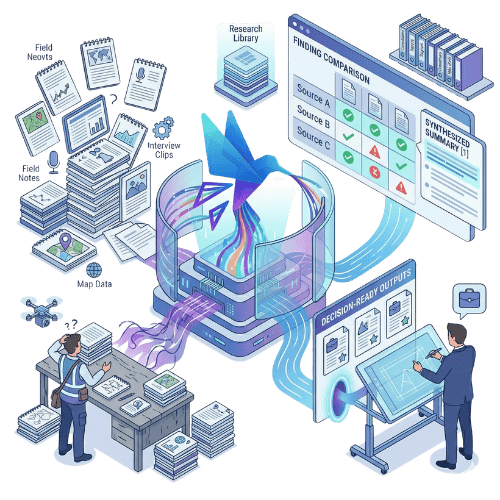
Doclarity.ai helps research, studies, program, and M&E teams consolidate field reports, source materials, and internal documents into one searchable working library. Retrieve grounded insights fast, compare findings across documents, and turn fragmented reporting into briefs, summaries, and decision-ready outputs.
Book a demo
See How It Work.

Built for teams working with field reports, studies, assessments, donor documents, internal notes, and research libraries.
Why it matters
Research and field teams often produce valuable material, but it ends up scattered across folders, email attachments, shared drives, and disconnected archives. Analysts waste time opening documents one by one, extracting recurring themes manually, and rebuilding the same synthesis every time leadership, donors, or program teams need an answer.
Doclarity gives your team a controlled document environment for reports, assessments, briefs, transcripts, and supporting materials. Upload the documents you trust, search them in natural language, retrieve source-backed answers, and turn multi-document analysis into usable outputs such as summaries, thematic briefs, donor notes, and internal decision support.
Outcomes
Bring assessments, mission reports, partner updates, interview notes, working papers, donor documents, and internal studies into one searchable library.

Ask questions across the full document base and get grounded answers that combine evidence from multiple sources instead of relying on one report at a time.
Identify patterns across locations, periods, projects, or respondents without manually rereading every file.
Generate executive summaries, bullet syntheses, briefings, Q&A documents, talking points, and structured writeups from your document base.
Keep source visibility so teams can move from synthesis back to the underlying report passages when they need to validate a claim.

Use shared workspaces, collaborative writing, and controlled sharing so research, program, and leadership teams can work from the same source base.
Capabilities
Combine insights across many reports, briefs, and source documents instead of reviewing files one by one.
Ask plain-language questions across the whole library and retrieve grounded answers with source references.
Continue investigations over time without restarting from zero each time a new question appears.
Generate executive summaries, briefing notes, article-style drafts, bullet summaries, FAQs, and custom outputs from the source corpus.
Use structured analytical approaches when shaping outputs for decision-makers and reviewers.
Work across PDFs, DOCX files, text files, images, and scanned documents with OCR support.
Filter by source, language, date, subject, document type, country, or other metadata to narrow analysis faster.
Track versions and recurring report series more cleanly when working with period-based or repeated publications.
Collaborate across research, program, and management teams in a shared environment with controlled access.
Export research findings and written documents in formats such as DOCX and PDF for circulation and review.
Workflow
Build a library from the reports your team actually uses: field reports, assessments, study documents, internal notes, donor materials, and supporting references.
Use semantic and hybrid search to ask natural-language questions, retrieve relevant passages, and compare findings across documents.
Turn retrieval into summaries, thematic syntheses, executive notes, briefs, and working drafts using AI writing and research workflows.
Collaborate in shared workspaces, refine outputs together, and export final materials for internal review, leadership, or external reporting.
Teams
This solution is especially strong for teams that already have valuable reports and source material, but need a faster, more reliable way to extract meaning from them.
 Research Directors Studies Managers Monitoring, Evaluation, and Learning teams Program Managers handling field reporting Policy and insight teams Knowledge management leads Small consulting and advisory teams working from document-heavy source bases
 Research and reporting work breaks down when teams cannot trust where an answer came from. Doclarity is built around your own curated document library, so your team works from the reports, briefs, assessments, and reference materials you choose to include.
That means synthesis is grounded in your sources, not invented from the open web. Your team gets better traceability, more consistent retrieval, and a stronger path from raw reports to credible outputs.
 Your documents, your control Multi-document synthesis with traceability Better collaboration on serious document work
 FAQ
Not exactly. It is a document intelligence platform for working with your own curated reports and source materials. It helps teams search, synthesize, compare, and generate outputs from the documents they already rely on.
Yes. Teams can upload reports from multiple sources and organize them using metadata, folders, and workspaces so they are easier to search and synthesize together.
Yes. Source-backed answers and citations help users move from a synthesized answer back to the underlying passages and documents.
Yes. It supports PDFs, DOCX files, text files, images, and scanned documents with OCR support for image-based files.
Yes. Teams can use shared workspaces, collaborative writing, and shared research threads to work from the same source base.
Yes. Research findings and written outputs can be exported in formats such as DOCX and PDF.
No. It is useful anywhere teams need to synthesize many internal or external documents into clearer insights, including research units, consulting teams, policy groups, and knowledge-heavy departments. View full FAQ
Solutions
With Doclarity.ai, your team can centralize reports, retrieve grounded answers faster, synthesize across many documents, and turn field knowledge into clearer decisions and better outputs. Build Your Private Library See How It Work.
 Private Secure Sovereign