Built for
Each requirement is marked demonstrated, partial, not established, contradicted, or to verify by interview or observation.

 English
Solutions
Consultants
Upload the client's procedures and records, choose the standard, and Doclarity prepares the analysis clause by clause, each point linked to its passage. You review it, and it's ready.
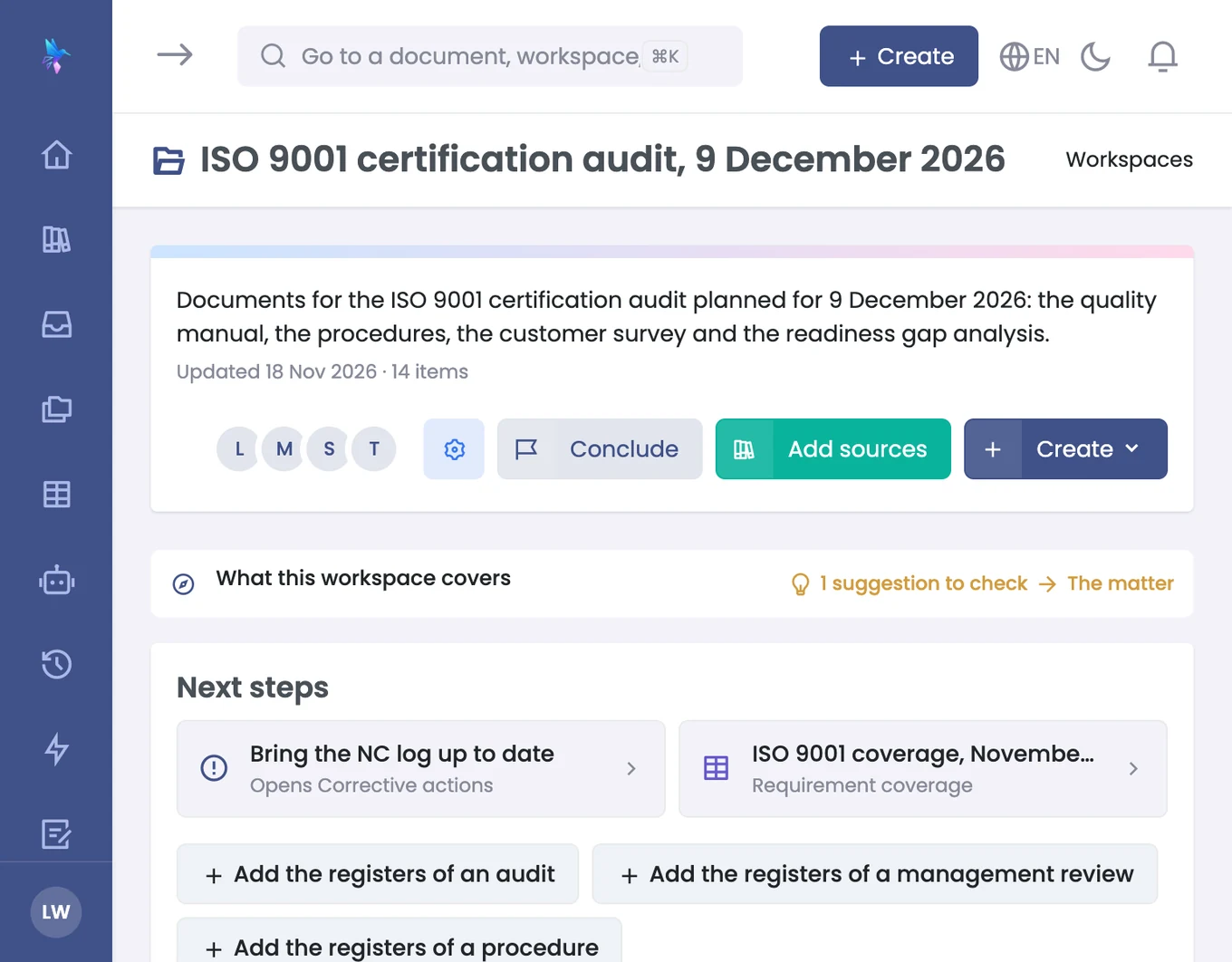
Each requirement is marked demonstrated, partial, not established, contradicted, or to verify by interview or observation.
Each status quotes the client's own passage, so you can show the client where it comes from.

Where the client's documents show nothing, the analysis says so and lists the evidence to ask for.
Why it matters
A gap analysis starts with the client's procedures, records and reports. Before any advice, you read them clause by clause and note where each requirement is shown. That reading takes days of the assignment. The client then asks where each finding comes from. A status in a spreadsheet does not say, and going back to the documents to prove it costs more time.
Upload the client's documents and the standard, and Doclarity prepares the analysis. Every requirement in scope gets one row, with its status, the client's passages and the document and page they come from. Where the documents show nothing, the row says « not established » and lists the evidence to ask for. Where only an interview or a visit can settle a point, the row gives the questions to ask on site. Your time on the assignment goes to your own judgement on what the gaps mean and what the client should do next.
Capabilities
Doclarity applies the frameworks you already use with clients (SCQA, the Pyramid Principle, MECE, an issue tree) to the client's own documents. Every point of the result links to the passage it comes from.
A management system standard, the client's customer requirements, an audit grid or a regulation.
Each row quotes the client's documents, with the document and page. The link opens the passage.
For each requirement that is not demonstrated, the documents or records the client should provide.
Requirements that need an interview or an observation come with the questions to ask.
Blank forms, examples, drafts and records from outside the period are flagged and never count as evidence on their own.
Gather the documents, the analysis and the follow-up of one matter in a workspace, with the colleagues you invite.
« Management Review Pack » gathers each input of the client's review from their records, with the source of each one.
« Procedure Writer » drafts procedures from the client's notes and old procedures, with a source on every step.
Use your Word template and writing style guide, edit the result, and export it to Word.
| Need | Spreadsheet | Chat assistant | Doclarity |
|---|---|---|---|
| Go through every requirement of the standard | Manual | Variable | Yes |
| Quote the client's passage behind each status | Manual | Rarely | Yes |
| Say when the client's documents show nothing | Manual | Rarely | Yes |
| Prepare the questions for the site visit | Manual | Variable | Yes |
| Decide what the gaps mean for the client | No | No | No |
Doclarity prepares the analysis from the client's documents. Your expertise decides what it means and what the client should do next.
Use cases
Check the client's documents against the standard before the first workshop.
Show the client which requirements still need evidence before the certification audit.
Use the interview questions the analysis gives for the points that documents cannot settle.
Gather the inputs of the review from the client's records, each with its source.
Draft procedures from the client's notes and old procedures, in the format you deliver.
Turn the gaps into a register and follow each one until it is closed.
Teams
Doclarity is less suited if most of the assignment happens on site through observation. It reads documents, and it marks the points only an interview or a visit can settle.
 an independent consultant in quality, environment, health and safety or information security; a small consulting firm preparing clients for certification; an adviser on regulatory compliance; a trainer or coach supporting a client's management system.
FAQ
No. The analysis is a self-assessment from the client's documents. The certification decision belongs to the auditor.
Any list of requirements you upload: a standard the client holds, a customer's requirements, an audit grid or a regulation.
The requirement is marked « not established », with the evidence to ask for. Doclarity never fills the gap with something that sounds right.
Yes. Use your Word template and writing style guide, edit the analysis, and export it to Word.
No. Documents are never used to train AI models, ours or anyone else's.
No. The requirement lists show the clause number and a short paraphrase in our own words, never the wording of the standard.
Solutions
Doclarity prepares your client's analysis from the client's own documents, with the passage behind every status. You review it, and it's ready.
 Sourced Up to date Honest