Analysis frameworks

The method consulting firms use, applied to your own documents.

Choose an analysis framework (SCQA, the pyramid, MECE, an issue tree…) and Doclarity builds the deliverable on it, each point with its source. Eleven frameworks, in the question box, research threads, AI Write and the writing agents.

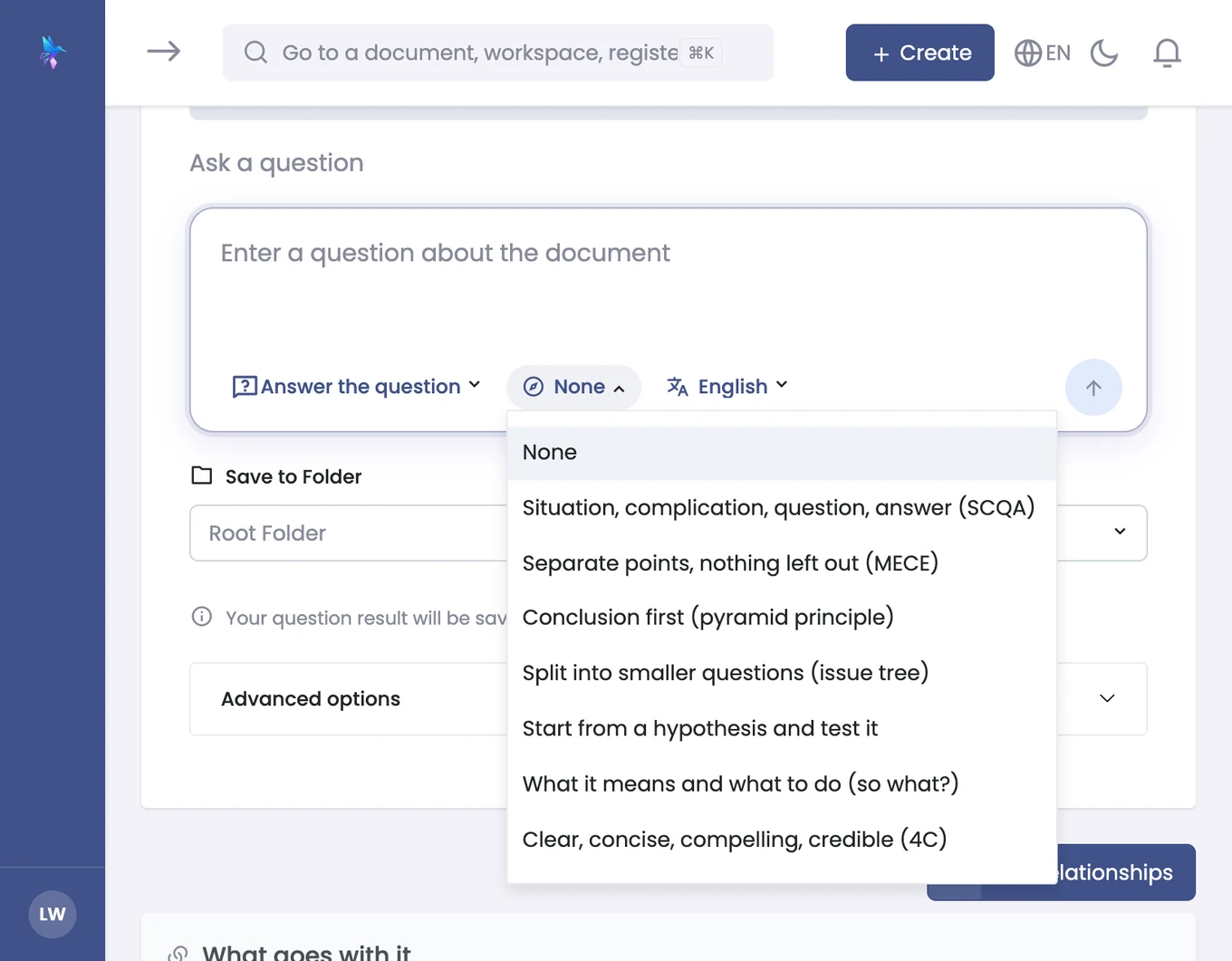
The framework menu of a document’s question box: SCQA, MECE, the pyramid principle, the issue tree and the other structures an answer can follow

Where you choose one

A framework wherever Doclarity writes for you

Pick the framework before you ask or write. Every point of the answer or the deliverable stays linked to its source passage.

The question box

On Home, and in « Query this document » on a document page, choose a framework under « Structure of the answer » before you ask.

Research threads

Each question you ask in a research thread can take its own framework.

AI Write in the editor

In the AI Write dialog, « Structure of the answer » shapes the text Doclarity writes into your document.

Writing agents

Agents that prepare a written deliverable from your documents offer a framework in their form.

The eleven frameworks

What each one does, and when to use it

Each example comes from Varnell Components, a precision parts maker preparing its ISO 9001 certification audit.

Fixed parts, in order

SCQA

Situation, Complication, Question, Answer

What it is

A storyline in four parts. It starts from facts the reader already accepts, shows what disturbs them, states the question this raises, then answers it.

When to use it

Use it when a reader must follow you from the facts to a recommendation, as in a briefing or a decision note.

Parts

  • Situation
  • Complication
  • Question
  • Answer

In the menu « Situation, complication, question, answer (SCQA) »

How to use it in Doclarity
Example Is Varnell ready for its ISO 9001 certification audit?
Situation
Complaints are handled under QP-03 Revision C, the edition in force (QP-03, p. 2).
Complication
The internal audit raised corrective actions CA-26-14 to CA-26-16 (RPT-01).
Question
What must be closed before the auditor arrives?
Answer
The three corrective actions, with their evidence recorded as QP-04 requires (RPT-01, QP-04).

In the deliverable, headings describe your subject. The part names here only show the structure.

A rule for the whole text

MECE

Mutually exclusive, collectively exhaustive

What it is

A rule for splitting a subject. The parts never overlap, and together they cover everything the request asks for.

When to use it

Use it when you review a whole area, such as every process in scope of an audit, and nothing may be counted twice or left out.

Parts

  • Mutually exclusive
  • Collectively exhaustive

In the menu « Separate points, nothing left out (MECE) »

How to use it in Doclarity
Example Audit readiness, process by process
Complaints
Handled under QP-03 Revision C (QP-03, p. 2).
Corrective actions
CA-26-14 to CA-26-16, followed under QP-04 (RPT-01).
Suppliers
Evaluated under QP-05, and covered in this part only.
Calibration
Measuring equipment under QP-06, and covered in this part only.

In the deliverable, headings describe your subject. The part names here only show the structure.

Fixed parts, in order

Pyramid Principle

Answer first, then supporting arguments

What it is

The answer comes first, in one statement. Each section after it is one supporting argument, backed by the strongest evidence.

When to use it

Use it when your reader has little time and wants the conclusion before the detail.

Parts

  • Key message
  • Supporting arguments

In the menu « Conclusion first (pyramid principle) »

How to use it in Doclarity
Example Can Varnell go into its certification audit?
Key message
Yes, once CA-26-14 to CA-26-16 are closed (RPT-01).
Argument
Complaints run under QP-03 Revision C, the edition in force (QP-03, p. 2).
Argument
The open findings are known and tracked as CA-26-14 to CA-26-16 (RPT-01).
Argument
Customers scored delivery 3.9/5 and responsiveness 3.7/5, a baseline for the quality objectives (RPT-03, QM-03).

In the deliverable, headings describe your subject. The part names here only show the structure.

Fixed parts, in order

Issue tree

Problem, branches, synthesis

What it is

The problem is stated precisely, then split into distinct sub-issues. Each branch gets its own evidence, and a synthesis brings them together.

When to use it

Use it when a problem has several possible causes and you need to look at each one in turn.

Parts

  • Problem
  • Branches
  • Synthesis

In the menu « Split into smaller questions (issue tree) »

How to use it in Doclarity
Example Why do customers score responsiveness 3.7/5?
Problem
Responsiveness scores 3.7/5, below delivery at 3.9/5 (RPT-03).
Branch
Complaint handling, as QP-03 Revision C sets it out (QP-03, p. 2).
Branch
Follow-up of corrective actions under QP-04.
Synthesis
What the sources show across both branches, and what they leave open.

In the deliverable, headings describe your subject. The part names here only show the structure.

Fixed parts, in order

Hypothesis-driven

Hypothesis, evidence, challenge, conclusion

What it is

You state a working answer in one sentence, then set the evidence for it against the evidence and explanations that challenge it.

When to use it

Use it when you already suspect the answer and want to test it fairly against the documents.

Parts

  • Hypothesis
  • Supporting evidence
  • Challenge
  • Conclusion

In the menu « Start from a hypothesis and test it »

How to use it in Doclarity
Example Do slow complaint replies explain the responsiveness score?
Hypothesis
Slow replies to complaints explain the 3.7/5 for responsiveness (RPT-03).
Evidence
QP-03 Revision C sets the reply steps (QP-03, p. 2), and responsiveness scores below delivery (RPT-03).
Challenge
The survey records scores, not causes, so other explanations stay open.
Conclusion
Plausible and not confirmed. The complaint records are the next check.

In the deliverable, headings describe your subject. The part names here only show the structure.

A rule for the whole text

So-what

Every point ends with its implication

What it is

Every key point ends with a short sentence on what it means for the reader. The implication is marked as an inference, never passed off as a new fact.

When to use it

Use it when facts alone will not move the reader and each finding needs its consequence spelled out.

Parts

  • Point
  • So what

In the menu « What it means and what to do (so what?) »

How to use it in Doclarity
Example Customer survey findings for the management review
Point
Customers scored delivery 3.9/5 and responsiveness 3.7/5 (RPT-03).
So what
Responsiveness is the weaker of the two, so the review should start there (inference).
Point
The internal audit raised CA-26-14 to CA-26-16 (RPT-01).
So what
The auditor will ask for their status, so their evidence belongs in the file first (inference).

In the deliverable, headings describe your subject. The part names here only show the structure.

A rule for the whole text

4Cs

Clear, concise, compelling, credible

What it is

A writing rule. Plain wording, no padding, what matters most to the reader first, and every claim backed by the sources with any uncertainty stated.

When to use it

Use it when the structure is settled and the text itself has to hold up for a demanding reader.

Parts

  • Clear
  • Concise
  • Compelling
  • Credible

In the menu « Clear, concise, compelling, credible (4C) »

How to use it in Doclarity
Example Customer satisfaction, one paragraph for the board
Clear
Responsiveness scored 3.7/5 and delivery 3.9/5 (RPT-03).
Concise
One sentence per finding, with no background repeated.
Compelling
The weaker score comes first, because the review has to act on it.
Credible
Each figure cites RPT-03, and what the survey cannot show is stated.

In the deliverable, headings describe your subject. The part names here only show the structure.

Fixed parts, in order

DARE

Data, Analysis, Recommendation, End

What it is

The data with its sources, then what it means, then a recommendation with the options weighed, and an end that names the decision requested and the next steps.

When to use it

Use it when you present figures and must close on a decision, as in a management review.

Parts

  • Data
  • Analysis
  • Recommendation
  • End

In the menu « Data, analysis, recommendation, end (DARE) »

How to use it in Doclarity
Example Customer satisfaction input to the management review
Data
Delivery 3.9/5, responsiveness 3.7/5 (RPT-03).
Analysis
Both scores set against the quality objectives (QM-03, RPT-03).
Recommendation
Review the reply steps of QP-03 Revision C (QP-03, p. 2).
End
The decision asked of management, and owners where the sources name them.

In the deliverable, headings describe your subject. The part names here only show the structure.

Fixed parts, in order

DRIVE

Do, Redo, Investigate, Validate, Execute

What it is

Five steps for work already under way. What has been done, what must be redone, what to investigate, how fixes are confirmed, and the plan to carry out.

When to use it

Use it when you report on corrective work in progress and the steps still ahead.

Parts

  • Do
  • Redo
  • Investigate
  • Validate
  • Execute

In the menu « Do, redo, investigate, validate, execute (DRIVE) »

How to use it in Doclarity
Example Corrective actions from the internal audit
Do
The internal audit raised CA-26-14 to CA-26-16 (RPT-01).
Redo
Records that do not meet QP-04 are corrected.
Investigate and validate
Causes analysed, then effectiveness checked before closure (QP-04).
Execute
The steps, their order and their owners before the audit.

In the deliverable, headings describe your subject. The part names here only show the structure.

Fixed parts, in order

STAR

Situation, Task, Action, Result

What it is

A short case in four parts. The context, the task that had to be met, the actions taken in order, and the results they achieved.

When to use it

Use it when you need to show what was done and what it achieved, for an auditor or a client.

Parts

  • Situation
  • Task
  • Action
  • Result

In the menu « Situation, task, action, result (STAR) »

How to use it in Doclarity
Example Calibration of measuring equipment
Situation
Varnell is preparing its ISO 9001 certification audit.
Task
Show that measuring equipment is calibrated as QP-06 requires.
Action
Records checked against QP-06, with any gap handled under QP-04.
Result
The outcome, with figures only where the records give them.

In the deliverable, headings describe your subject. The part names here only show the structure.

Fixed parts, in order

5W1H

Who, What, When, Where, Why, How

What it is

Six plain questions that cover the facts of a subject. Who is involved, what happened, when and where, why, and how.

When to use it

Use it when you need a complete factual account before any analysis.

Parts

  • Who
  • What
  • When
  • Where
  • Why
  • How

In the menu « Who, what, when, where, why, how (5W1H) »

How to use it in Doclarity
Example How Varnell handles a customer complaint
Who and what
The roles and steps QP-03 Revision C names for recording and answering a complaint (QP-03, p. 2).
When and where
The deadlines and the scope the procedure sets.
Why
Customer satisfaction, where responsiveness scored 3.7/5 (RPT-03).
How
The steps, and the hand-over to QP-04 when a complaint reveals a nonconformity.

In the deliverable, headings describe your subject. The part names here only show the structure.

See it on your documents

Bring one of your own questions and pick a framework

In a demo we run your question through the framework you choose, on documents like yours, and open the sources behind each point.

Every point sourced Edition in force Your documents only